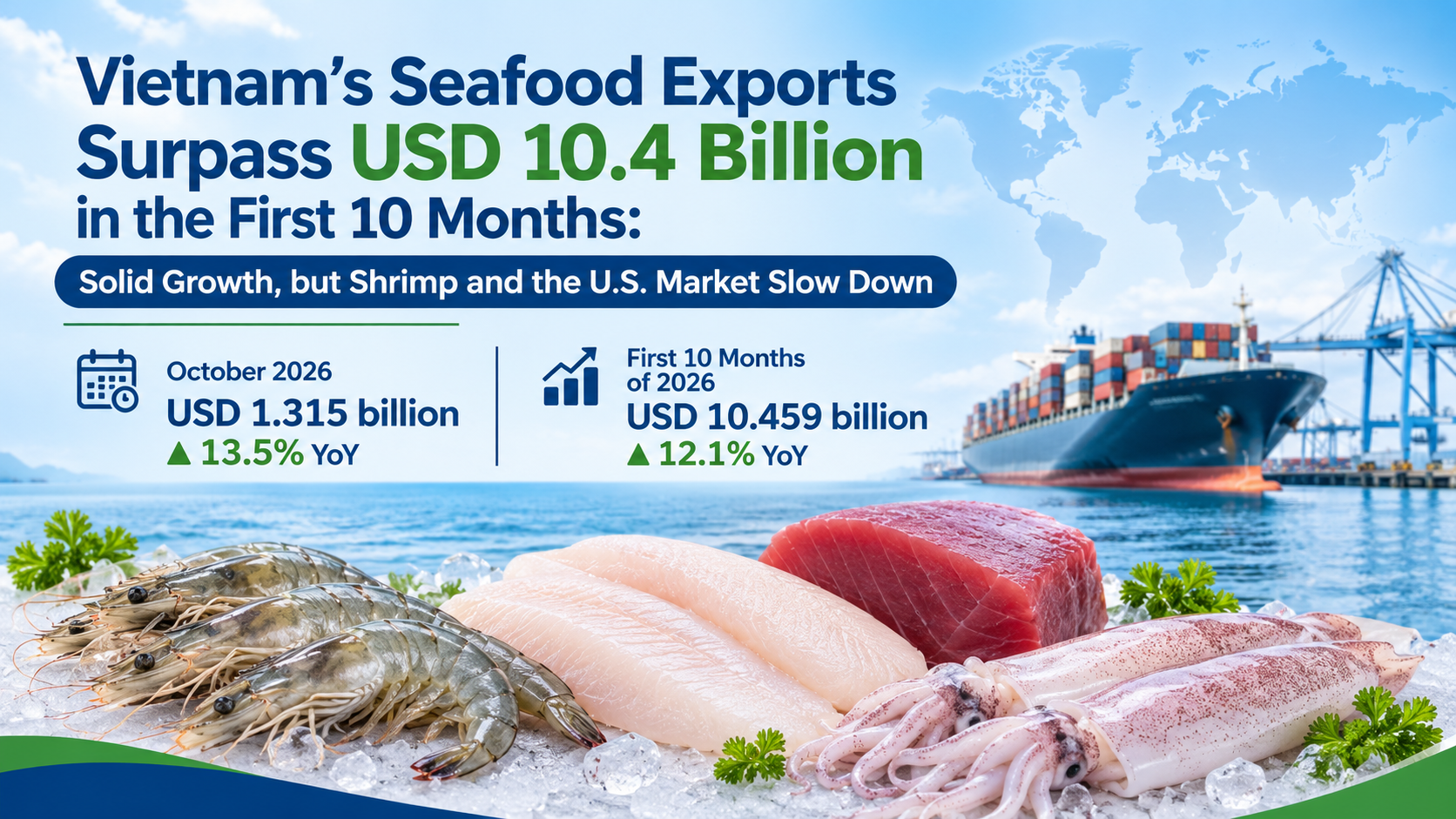
According to VASEP, Vietnam’s seafood exports in October 2026 were estimated at USD 1.315 billion, up 13.5% year-on-year, bringing total export value for the first 10 months of 2026 to USD 10.459 billion, an increase of 12.1%. However, growth is increasingly driven by fish products and Asian markets, while shrimp exports have declined and the U.S. market has shifted to negative growth. The final results of the 20th administrative review (POR20) of anti-dumping duties on shrimp, expected in early November, will be an important factor shaping the outlook for the coming months.
In October, exports of other fish products were estimated at USD 309 million, up 55%, representing an increase of nearly USD 110 million. This category alone accounted for approximately 70% of the total increase in the seafood industry's export value during the month. Pangasius exports reached more than USD 249 million, up 14.9%, while tuna increased by 13.4% and squid and octopus by 14.8%.
In contrast, shrimp exports reached nearly USD 474 million, down 4.9%, with whiteleg shrimp exports falling 8.3% to nearly USD 307 million. For the first 10 months of the year, whiteleg shrimp exports totaled USD 2.62 billion, representing an increase of just 4%.
Meanwhile, green lobster exports reached nearly USD 915 million, up 31%, contributing more than USD 216 million, or approximately 62% of the total increase in shrimp export value. This indicates that the 9% growth in overall shrimp exports has been significantly supported by lobster, while whiteleg shrimp – a key product in Vietnam's shrimp farming and processing industry – has recorded relatively modest growth.
This trend is consistent with the broader picture of international shrimp consumption. U.S. shrimp imports fell by 0.7% in the first eight months of the year, while imports into the EU declined by 2.3%. In contrast, China recorded an increase of 25.5%. Demand has yet to recover evenly across markets, while Ecuador's shrimp export volume increased by as much as 19.8% over the same period. As a result, Vietnamese shrimp exporters cannot rely on a general market price increase to drive export growth in the final months of the year.
Pangasius, on the other hand, has a more favorable outlook. Its export value for the first 10 months approached USD 2 billion, up 11%. Atlantic cod prices have remained high due to limited supply, while Alaska pollock has also faced pressure from raw material prices. The price gap between wild-caught fish and farmed fish creates additional opportunities for distributors to turn to pangasius as a competitively priced option in the whitefish segment.
China–Hong Kong reached USD 2.62 billion in seafood import value from Vietnam during the first 10 months, up 30.3%, accounting for approximately 54% of the industry's total export growth. ASEAN reached USD 722 million, an increase of 22.9%.
Combined, these two markets generated nearly USD 745 million in additional export value, representing approximately two-thirds of the industry's total increase.
The EU and Japan showed improvement in October, with export growth of 22.1% and 6.7%, respectively. This brought their cumulative growth for the first 10 months to 1.1% and 2.8%. Nevertheless, the combined increase in export value to these two markets was only around USD 49 million, relatively small compared with the contributions from China and ASEAN.
The U.S. market remains a greater concern. Exports to the U.S. fell 11.8% in October to nearly USD 200 million, bringing the cumulative export value for the first 10 months down to USD 1.63 billion, a decline of 1.2%.
The downturn in the U.S. market coincided with the decline in whiteleg shrimp exports, indicating that the market remains a major obstacle to the recovery of Vietnam's shrimp export sector.
The preliminary results of POR20 set anti-dumping duty rates at 6.30% for STAPIMEX, 10.76% for the Fimex group, and 7.56% for 27 companies receiving separate rates.
The final results, expected in early November, will partly determine export costs and the ability of Vietnamese shrimp exporters to secure orders from the U.S. market.
If the final duty rates are significantly lower than the preliminary levels, prospects for order negotiations could improve. However, with only a short period remaining in the year, the impact may become more evident in orders for early 2027.
If the duties remain close to or higher than the preliminary rates, a strong recovery in shrimp exports to the U.S. market in the near term will be difficult to expect.
After the first 10 months, Vietnam's seafood exports would need to average approximately USD 770 million per month over the final two months to reach the USD 12 billion target. This is considerably lower than the estimated export value recorded in October, making the USD 12 billion target achievable.
However, the potential to exceed this target by a significant margin will still depend on whether China and ASEAN can maintain their purchasing demand, as well as the extent of shrimp export recovery following the POR20 results.